
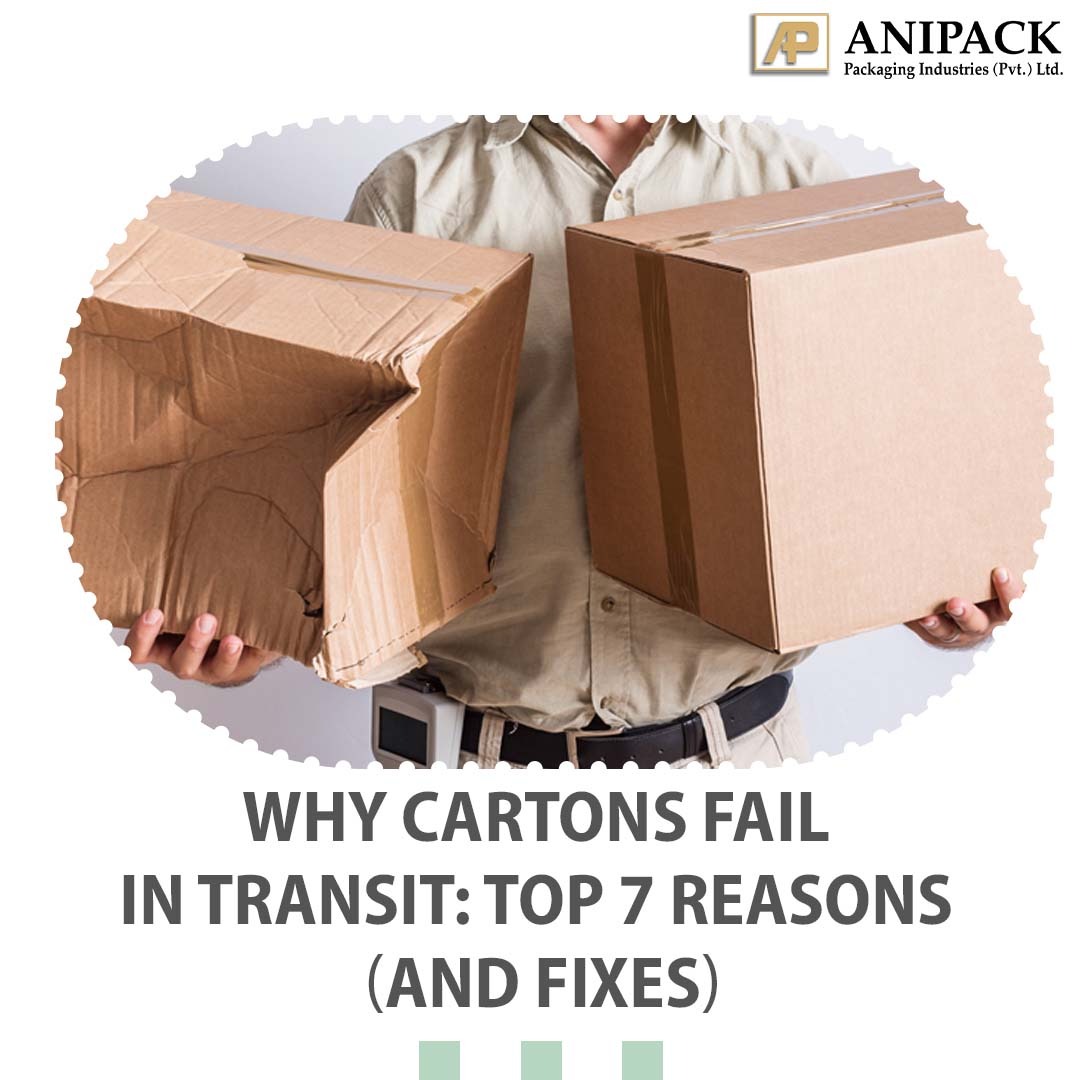
Carton failure during transit is one of the most expensive and frustrating problems for businesses. When boxes collapse, tear, or deform, the real loss is not the carton — it’s the damaged product, delayed deliveries, rejected shipments, and unhappy customers.
At ANIPACK Packaging Industries, with over two decades of experience supplying cartons across Pakistan, we’ve identified the most common reasons cartons fail in transit — and how they can be fixed.
1️⃣ Wrong Carton Strength Selection
The problem:
Using cartons that are not designed for the product’s weight or stacking requirements.
Many businesses choose cartons based on price instead of engineering.
The fix:
- Select cartons based on product weight, stacking height, and route
- Use the correct flute type (B, C, BC)
- Consider ECT and compression strength, not just thickness
ANIPACK helps clients choose the right strength, not an over- or under-designed box.
2️⃣ Poor Stacking & Palletization
The problem:
Even strong cartons fail when stacked incorrectly.
Common mistakes:
- Over-stacking
- Leaning stacks
- Uneven pallets
- Cross-stacking without support
The fix:
- Stack cartons column-style (edge over edge)
- Use level, undamaged pallets
- Follow safe height limits based on carton strength
Correct stacking alone can reduce transit damage significantly.
3️⃣ Humidity & Moisture Exposure
The problem:
Pakistan’s climate — especially during monsoon — weakens corrugated board.
Moisture:
- Softens paper fibers
- Reduces compression strength
- Causes warping and collapse
The fix:
- Store cartons off the floor
- Use poly-bagging or shrink wrapping
- Avoid exposure to rain and damp warehouses
- Select moisture-resistant board combinations when needed
ANIPACK designs cartons considering local climate conditions, not ideal lab environments.
4️⃣ Improper Internal Fit
The problem:
Products moving inside the box create internal pressure and impact.
This leads to:
- Burst panels
- Deformed cartons
- Product breakage
The fix:
- Use properly sized cartons
- Add partitions or inserts where required
- Avoid oversized boxes with empty space
A well-fitted carton protects both the product and the box itself.
5️⃣ Weak Glue Joints & Poor Conversion
The problem:
Cartons fail when glue seams open during handling or vibration.
This usually happens due to:
- Poor-quality adhesive
- Dust contamination
- Incorrect pasting pressure
The fix:
- Ensure strong glue application
- Maintain clean conversion environments
- Use experienced operators
At ANIPACK, all conversion is done in-house, allowing full quality control over glue strength and finishing.
6️⃣ Rough Handling During Transport
The problem:
Manual loading, unloading, and long-distance road transport cause sudden shocks.
The fix:
- Design cartons with a safety margin
- Reinforce edges for heavy products
- Use correct pallet strapping and stretch wrap
Packaging must be engineered for real-world handling, not just theory.
7️⃣ Overloading the Carton
The problem:
Using cartons beyond their designed load capacity.
This often happens when:
- More items are added to save space
- Product weight changes without updating packaging
The fix:
- Match carton design to actual filled weight
- Re-evaluate packaging when product specs change
Final Thought
Carton failure is rarely caused by one issue — it’s usually a combination of poor design, wrong handling, and environmental factors.
With the right engineering and guidance, most transit failures are completely avoidable.
Need Help Reducing Transit Damage?
ANIPACK Packaging Industries helps businesses design cartons that survive Pakistan’s transport realities.
Visit www.anipack.pk
Share your product details and route
Get a strength and design recommendation
ANIPACK Packaging Industries — Packaging That Performs Beyond the Warehouse.